

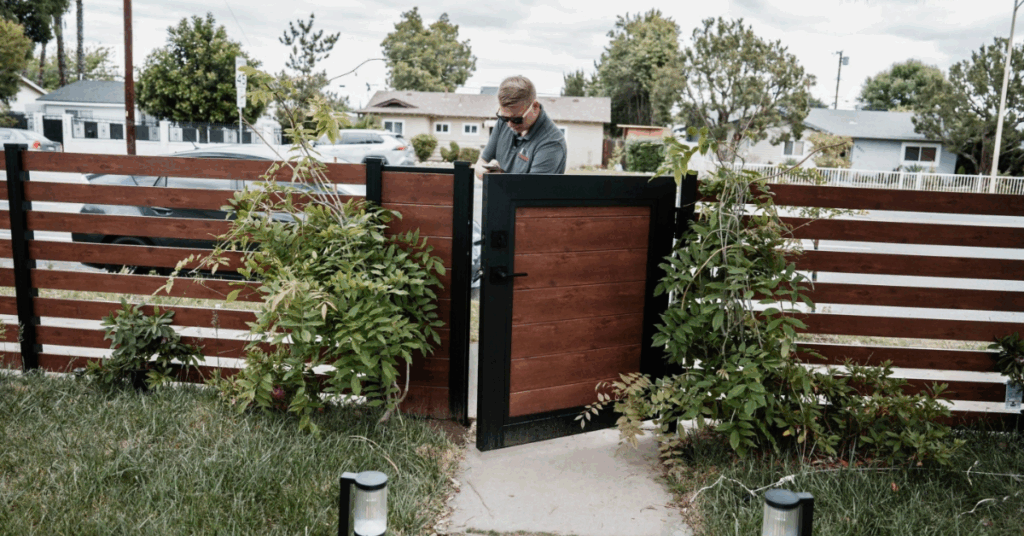
An aluminum pedestrian gate is one of the smallest moving structures on a property, but it is often the one used most frequently. Side-yard gates, courtyard entries, pool barriers and front walk gates can open dozens of times in a day, which means the frame, hinges, posts, lock, closer, bottom clearance and privacy design all have to work together long after the gate first looks perfect.
Los Angeles properties make that planning more complicated. Narrow side yards, masonry walls, sloped walkways, pool areas, coastal exposure and modern privacy expectations all change the right solution. A six-foot full-privacy gate between block walls should not be designed like an open front-yard gate, and a self-closing pool gate needs different hardware behavior from a decorative courtyard entrance.
This guide explains how homeowners, contractors, builders and designers can choose aluminum pedestrian and side gates for Los Angeles properties, including horizontal and vertical designs, T&G privacy, louvers, translucent panels, structural frames, posts, locks, self-closing hardware, pool requirements, wildfire-conscious materials and professional installation.
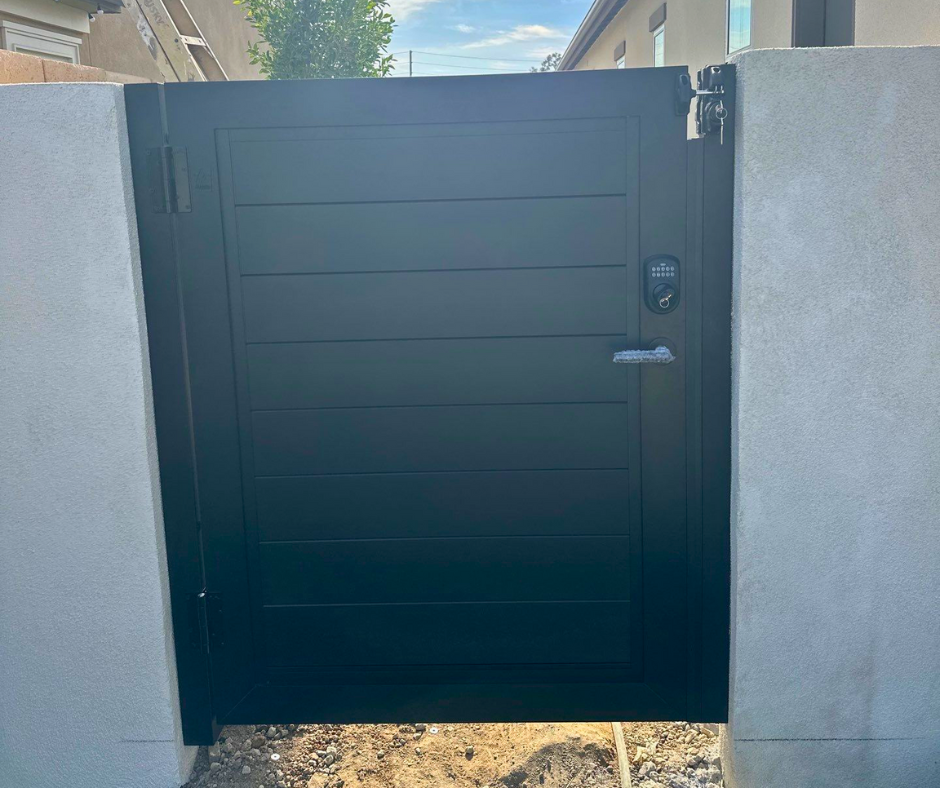
Why Pedestrian Aluminum Gates Deserve Their Own Guide
Pedestrian gates are often treated as smaller versions of driveway gates, but that assumption misses how differently they are used. A driveway gate may cycle a handful of times in a day, while a side-yard or courtyard gate can be opened constantly by family members, landscapers, pool service, contractors, deliveries and guests. That repeated daily use makes hinge alignment, latch position, closing force and frame stiffness more important than the compact size might suggest.
Pedestrian gates also interact with people at close range. The handle has to feel natural, the latch should engage without forcing the leaf upward, the gate should not slam, and the bottom gap should not become a trip or privacy problem. On a narrow Los Angeles side yard, a gate can sit inches from stucco, pool equipment or an air-conditioning condenser, so even a small change in swing direction or post location can affect whether the path remains usable.
The design challenge is therefore to combine architecture and repeated operation. Horizontal aluminum can align with a modern fence, T&G can create full privacy, louvers can ventilate an equipment area, and frosted translucent panels can preserve daylight. The visible style is flexible, but the frame, posts, hinges, lock and closer need to be selected around the actual opening and use pattern.
A pedestrian gate should be designed as a frequently used moving structure first and as a matching fence panel second. When that order is reversed, the most common problems are sagging, rubbing, poor latching and unreliable closing.
Side-Yard, Front Entry, Pool and Courtyard Gate Uses
A side-yard gate has a different job from a front entry gate even when both openings are the same size. Side-yard gates usually prioritize privacy, utility access and resistance to daily wear. They may need to hide trash cans, mechanical equipment or service areas while remaining easy for landscapers and pool technicians to operate. These gates often sit between walls where mounting conditions and bottom drainage matter more than decorative visibility.
Front pedestrian gates usually carry more architectural responsibility. They are part of the first impression of the property and may coordinate with a driveway gate, front fence, house numbers, intercom and landscape lighting. Because the street-facing entry is visible from both sides, hardware placement and the back of the gate deserve the same design attention as the front face.
Pool gates and courtyard gates introduce another set of requirements. Pool barriers can require self-closing and self-latching behavior, controlled opening sizes and a specific gate swing direction. Courtyard gates may be taller and more private because they protect living areas close to the house. The right gate therefore begins with a use-case question: who opens it, how often, what it needs to hide and whether it is part of a regulated barrier.
Pedestrian Gate Width, Height and Proportion
Pedestrian gate size should start with the clear opening people actually need, not simply with the distance between two existing walls. A narrow garden gate can work for ordinary foot traffic, while a side-yard gate may need enough width for trash bins, bicycles, wheelbarrows or maintenance equipment. If the opening is too tight, the gate becomes a daily inconvenience. If it is unnecessarily wide, the leaf creates more leverage at the hinges and can require stronger support.
Height is equally important because it controls privacy, proportion and wind surface. A shorter front gate can preserve street visibility and feel welcoming, while a six-foot or taller side-yard privacy gate creates a very different structural condition. The taller the leaf, the larger the surface exposed to wind and the more noticeable any post movement becomes at the latch side.
Proportion should relate to the surrounding architecture. A tall narrow gate often looks cleaner with vertical profiles, while a wider opening can support horizontal slats without making the gate feel squat. The best dimensions are therefore not universal standard sizes. They are the result of clear passage, privacy, local rules, wind exposure and the visual relationship to adjacent walls or fence panels.
Why the Pedestrian Gate Frame Matters
The frame is the part of the gate that keeps everything else working. Slats, louvers, T&G boards and translucent panels create the visible infill, but they should not be responsible for holding the leaf square or carrying concentrated hinge and lock loads. A rigid perimeter frame transfers the gate weight into the hinge side and keeps the latch side from dropping as the gate cycles.
Hardware preparation should be part of the frame design before fabrication. Hinges need reinforced connection areas, mortise locks need enough material around the lock body, and self-closing hardware can apply repeated force at the hinge stile. Cutting large holes or adding brackets after the gate is powder coated can remove reinforcement, expose raw metal and create an installation that looks improvised.
A clean modern appearance does not require a structurally frameless gate. The frame can be concealed behind cladding or integrated into the visible profile so it does not dominate the architecture. The important question is where the structure is and how it carries the moving leaf. A fence-style panel with hinges attached directly to decorative infill is not the same thing as an engineered pedestrian gate.
Horizontal Aluminum Pedestrian Gates
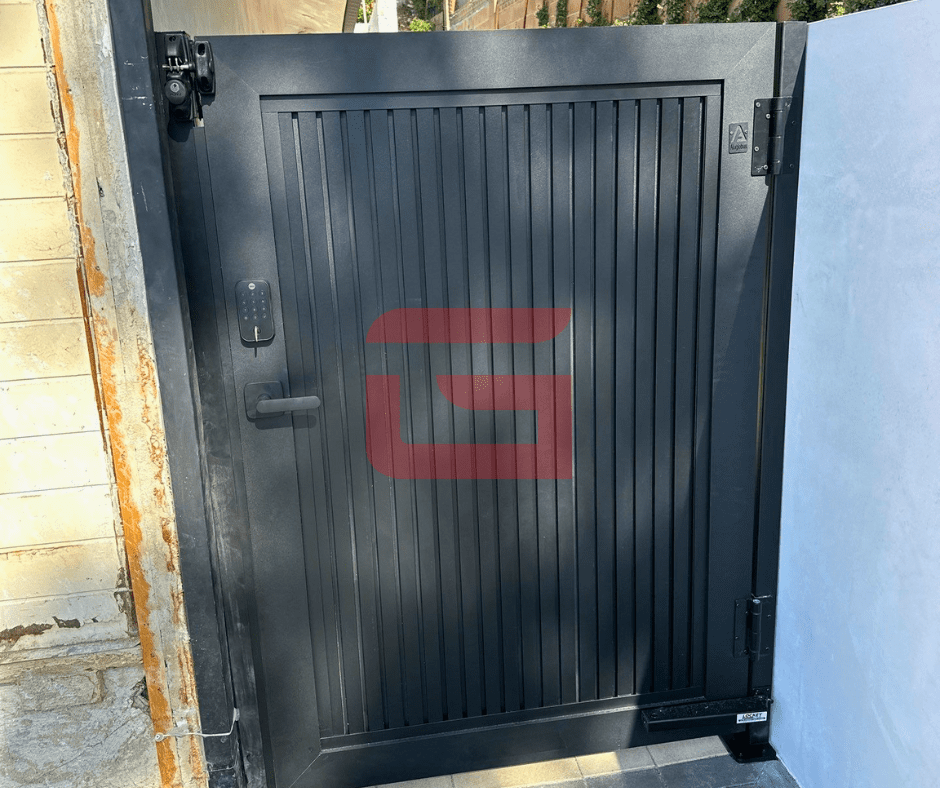
Horizontal aluminum gates are popular on contemporary Los Angeles homes because the long lines coordinate naturally with modern fencing, stucco walls, low rooflines and wide garage openings. Narrow profiles create a lighter, more open appearance, while wider slats and tighter gaps increase privacy. The design can be adjusted without changing the basic frame logic, which makes horizontal systems versatile across front entries, side yards and courtyard gates.
Alignment is especially important when the gate sits inside a matching fence. The slat courses should continue visually through the opening rather than jumping up or down at the hinge posts. That requires the gate bottom clearance, fence elevation and finished paving to be planned together. A gate installed after the fence without checking those lines can look like a replacement even when the material and color match perfectly.
Horizontal gates also make sag visible quickly because the slat lines act as level references. A small drop at the latch side can create a noticeable diagonal relationship against a square wall or fence bay. Strong posts, adjustable heavy-duty hinges and a rigid frame help keep those lines consistent through repeated use.
Vertical Aluminum Pedestrian Gates
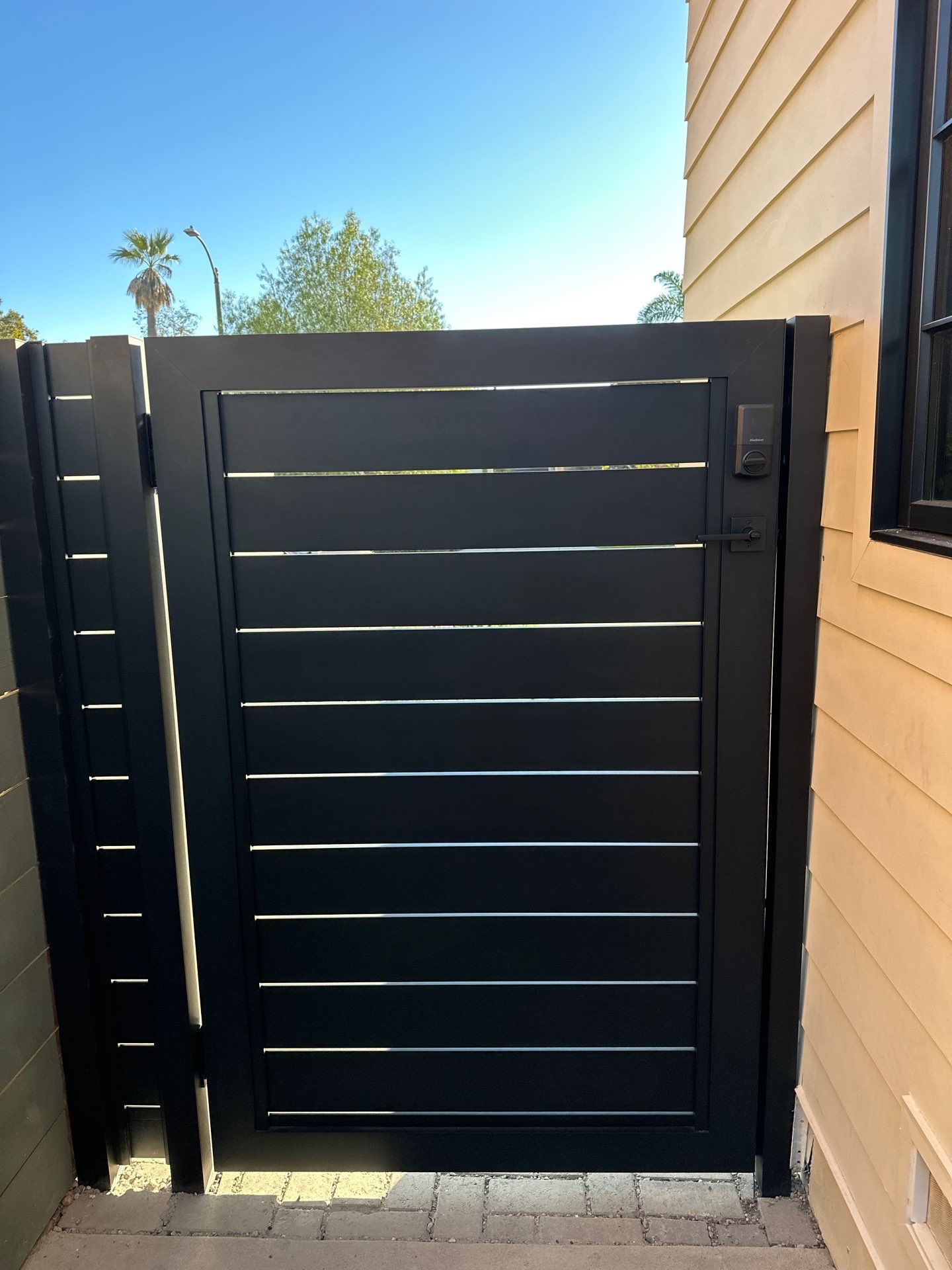
Vertical aluminum profiles create a different architectural effect. They emphasize height, can make a narrow opening feel more intentional and often work well on front walk gates where the design wants more visibility than a solid privacy panel. Vertical members can be open, closely spaced or combined with a deeper frame to tune the balance between security and openness.
From an installation standpoint, vertical profiles reduce the strong horizontal reference lines that make minor sag immediately obvious, but they do not eliminate the structural need for a rigid gate frame. The hinge side still carries the entire leaf, and a tall vertical gate can create significant wind pressure. The frame and post system should therefore be selected from the finished height and infill density rather than from appearance alone.
Vertical gates are also useful where the surrounding architecture already contains strong vertical elements such as narrow windows, board-and-batten cladding, tall landscape screens or pilasters. Matching those proportions can make the gate feel integrated without copying every material on the building. A black or bronze vertical aluminum gate can serve as a quiet transition between masonry and landscaping rather than becoming a decorative object on its own.
Open, Semi-Private and Full-Privacy Pedestrian Gates
Privacy is not a single setting. An open gate allows clear views and airflow, which can be appropriate at a front walkway where visibility and neighborhood connection matter. Semi-private gates use controlled gaps that soften direct views while keeping the passage lighter and more ventilated. Full-privacy gates use T&G, cladding or other continuous infill to block direct sightlines completely.
The correct choice depends on what is behind the gate. A side yard containing trash bins or pool equipment may justify full privacy, while a front gate that hides an entire porch can make the property feel less welcoming than intended. A courtyard beside a busy street may need stronger screening, but a narrow service passage can become dark and hot behind a completely solid panel. Privacy should therefore be designed around actual viewpoints, airflow and the way the space is used.
Perimeter gaps matter just as much as the infill. A full-privacy gate with a large bottom gap or an oversized space beside the latch post can reveal more than the panels hide. Those clearances need to be controlled without making the gate bind against paving, masonry or expansion. The best privacy gate feels closed visually while still moving freely through weather and minor building movement.
Tongue-and-Groove Aluminum Pedestrian Gates
Tongue-and-groove aluminum creates one of the cleanest full-privacy pedestrian gate faces because adjacent profiles interlock instead of relying on visible gaps. The result reads more like a solid architectural panel than a conventional fence gate, which makes T&G especially useful for side yards, private courtyards and pool equipment areas where direct views need to disappear.
The continuous surface changes the structural condition. Wind cannot pass through the leaf the way it does through an open slat design, so the gate frame, hinges and posts carry greater pressure. A tall T&G pedestrian gate between freestanding posts should therefore not be treated as a lightweight small gate simply because the opening is narrow. The support system should reflect the solid area and site exposure.
T&G also rewards precise perimeter detailing. The no-gap face looks premium only when the bottom clearance, side reveals and lock hardware remain equally controlled. A clean frame can hide fasteners and reinforce the lock stile, while proper drainage below the gate prevents the privacy design from becoming a dam across a sloped or narrow side passage.
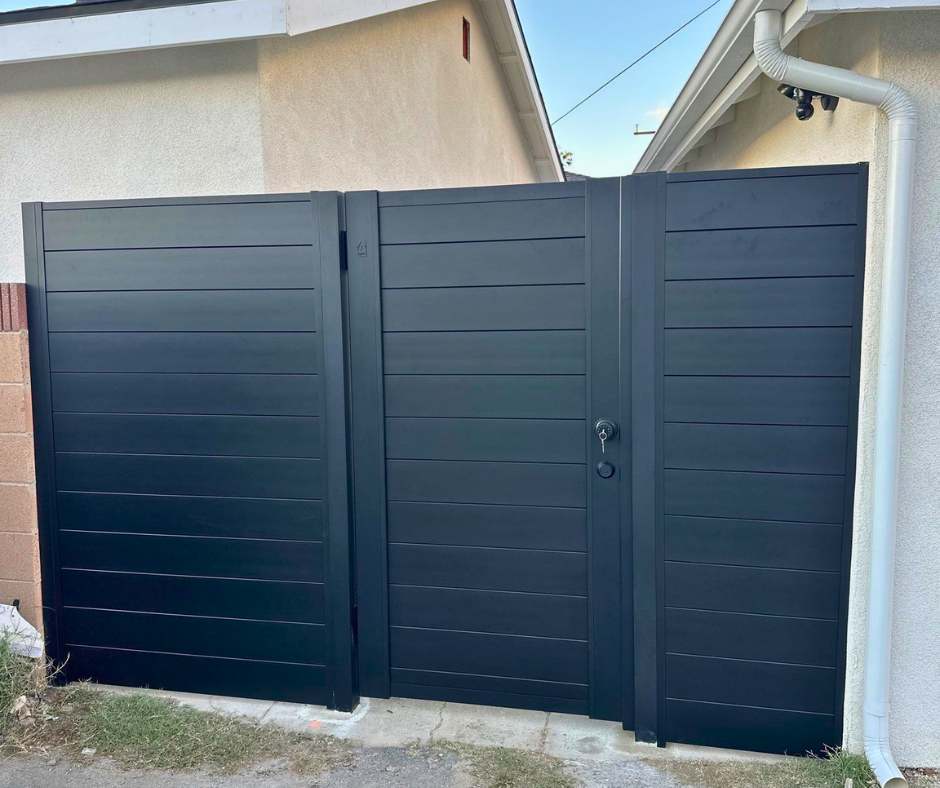
Louvered Aluminum Pedestrian Gates
Louvered gates solve a problem that flat slats cannot solve as efficiently: they can block direct sightlines while maintaining a deliberate air path through the opening. Angled blades make the gate appear visually closed from a normal viewing position, but the spaces between the blades allow ventilation. That makes louvers useful around pool equipment, condensers, utility zones and courtyard entries where a solid gate could trap heat.
The viewing angle matters. A louver pattern that blocks sightlines from the street may appear more open from a lower or higher position, so the blade direction should be reviewed from both sides and from realistic eye levels. This is particularly important on sloped walkways where the ground elevation changes across the gate opening.
Louvered infill still needs a structural perimeter frame because the angled blades are not the hinge structure. The depth of the louver also affects the gate thickness, lock setback and trim around masonry. Hardware should be selected after the complete panel geometry is known so handles and latches remain comfortable to operate without colliding with the blade field.
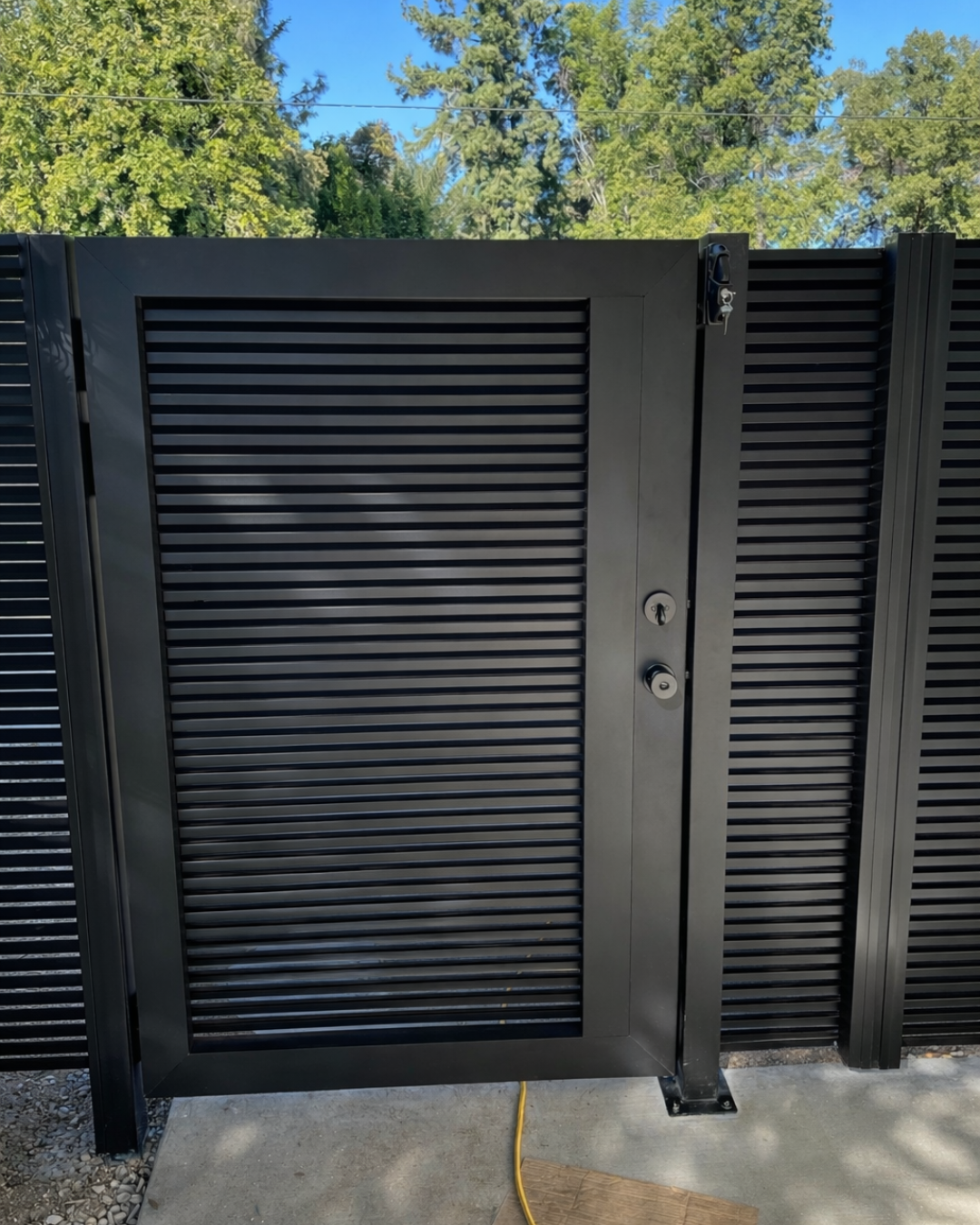
Translucent and Acrylic Aluminum Gates
Translucent infill creates a different type of privacy from slats or louvers. Frosted acrylic or similar panels can admit daylight while obscuring direct views, which can be useful in narrow side yards and courtyards that would feel too dark behind a solid metal gate. Clear panels can preserve visibility where the goal is separation rather than privacy, while opaque panels can make the system visually closer to a solid gate.
The panel should be retained inside a structural aluminum frame rather than used as the structural gate leaf. Acrylic and related materials respond to temperature differently from aluminum and can expand, contract or scratch. The retaining detail should allow appropriate movement without clamping the panel so tightly that stress develops around fasteners or corners.
Cleaning and service also differ from powder-coated aluminum. Abrasive cleaners can scratch a clear or frosted surface, and replacement may be necessary if a panel is deeply damaged. The advantage is flexibility: a properly designed frame can sometimes allow the infill to be replaced without rebuilding the entire gate, making translucent systems useful where the homeowner may want to change privacy or appearance later.
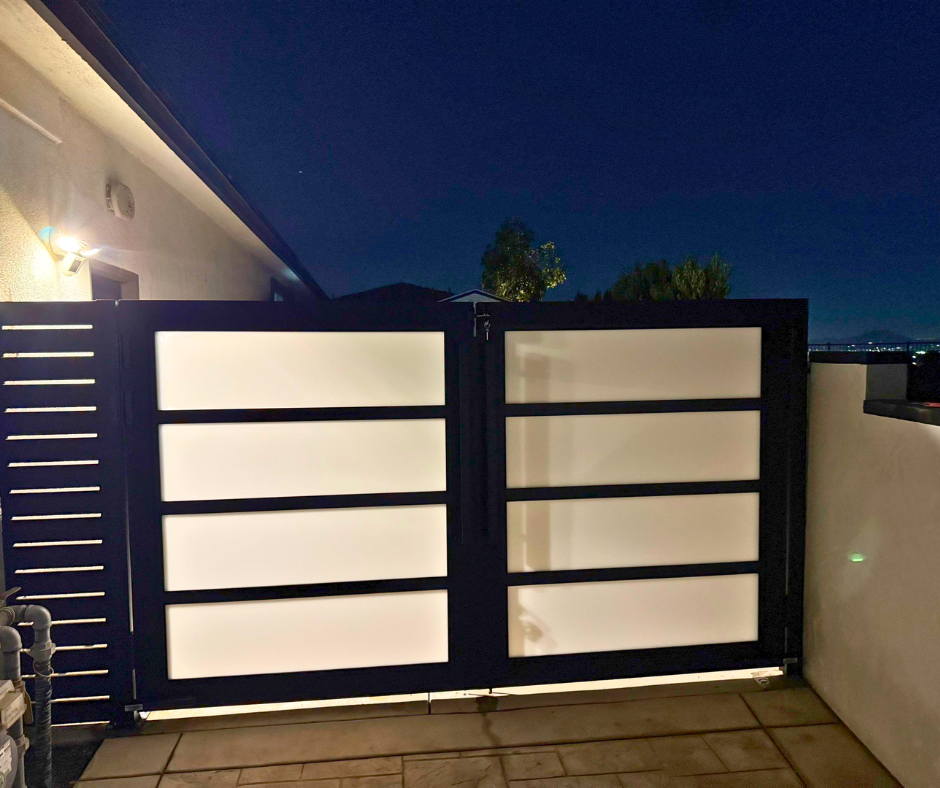
Wood-Look Aluminum Pedestrian Gates
Wood-look aluminum gives side and entry gates a warmer residential character without making natural wood the moving structural material. That can be especially useful on modern Los Angeles homes that already use wood-look cladding, warm garage doors or natural stone. The gate can visually soften black windows and stucco while retaining an aluminum frame and low-maintenance exterior surface.
Grain direction affects the appearance. Horizontal wood-look profiles can make a narrow side gate feel wider, while vertical grain can emphasize height and work well on a tall courtyard entrance. The pattern should coordinate with adjacent fencing or cladding without forcing an exact match where different profile widths would make the repetition awkward.
Wood-look finishes still need normal exterior care. They should be protected during installation, cleaned without abrasive chemicals and reviewed from physical samples rather than screen images. When a gate and fence are intended to match closely, ordering coordinated finish batches can reduce visible variation. The design benefit is a natural visual language without the swelling, splitting or refinishing cycle associated with exposed wood gate boards.
Gate Posts, Walls and Masonry Support
A pedestrian gate can be supported by freestanding posts, mounted between structural walls or installed between masonry columns. Each condition changes the way loads reach the building or ground. Freestanding hinge posts need adequate section size and foundations because the entire leaf hangs from one side. A receiver post carries the latch and closing impact and should remain aligned even if landscaping or paving around it settles.
Wall-mounted gates can reduce the number of visible posts, but the wall has to contain suitable structure. Stucco, stone veneer and decorative tile are finishes, not hinge substrates. The installer should identify reinforced masonry, concrete, steel or framed backing behind the finish and use an attachment method appropriate to that material. Anchoring only to the surface can create cracking and movement long before the aluminum frame itself has any problem.
Masonry columns require the same verification. A large decorative column can be hollow or contain only limited reinforcement, while a visually smaller column can hide structural steel. New construction is the easiest time to coordinate embedded plates or posts inside the masonry so the gate hardware connects to real structure without oversized surface brackets. The cleanest pedestrian gate installations usually begin with invisible support planned before the finish work.
Hinges and Pivot Hardware for Pedestrian Gates
Hinges determine how the gate feels every time someone uses it. A compact aluminum gate can use adjustable barrel hinges, butt hinges, self-closing hinge systems or other hardware depending on frame design and mounting condition. The correct hinge is selected from the actual leaf weight, width, expected cycle count and required adjustment rather than from appearance alone.
Adjustability is valuable because exterior gates live in moving environments. Posts can settle slightly, masonry can shift and temperature changes can affect clearances. A good hinge allows small corrections without drilling new holes or lifting the gate off the post. That does not mean hinge adjustment should be used to hide a failing foundation or a frame that has racked out of square. When a gate repeatedly needs large adjustment, the support condition should be investigated.
Hinge placement also changes how force enters the frame. Spreading hinges vertically can improve control on a tall gate, while dedicated reinforcement behind each hinge prevents localized deformation. Closers and self-closing hinges add repeated spring force, so their attachment areas should be prepared before powder coating. The finished installation should open smoothly without hinge binding and should close without forcing the leaf sideways against the latch post.
Locks, Latches and Handle Planning
The lock is the part of the gate users interact with most directly, so it should be selected before the frame is finalized. Simple side-yard gates may use a mechanical latch or keyed lever, while front entries can use mortise locks, deadlatches, electric strikes or other access-control hardware. Each option requires a specific frame depth, backset and strike location, and those dimensions should be coordinated before fabrication rather than cut into a finished gate in the field.
Privacy gates create additional hardware questions because the solid infill can block access to the inside handle or make a latch easy to reach through a gap. The gate design should consider who needs entry from each side and whether the outside should have a handle, key cylinder, keypad or no visible release at all. Security improves when the hardware and infill are planned together rather than when a generic latch is attached after the gate arrives.
The receiving side matters just as much as the lock body. A strike plate mounted to a moving or out-of-plumb post will create inconsistent latching even when the lock is high quality. The gate should close against an appropriate stop or receiver so the latch engages without absorbing all of the closing impact. A lock is an access-control device, not a substitute for a structural stop.
Self-Closing Hinges, Hydraulic Closers and Reliable Gate Closing
Self-closing hardware is useful when a gate should return to the closed position after every use, but closing force needs to be matched to the gate instead of simply increased until the latch catches. A heavy privacy leaf, tall wind-exposed gate or gate with significant hinge friction can exceed what a light spring hinge can control consistently. In those cases a hydraulic closer or a properly sized multiple-hinge arrangement can provide smoother and more predictable movement.
The best closer cannot fix bad geometry. If the hinge post leans, the bottom rail drags or the latch is misaligned, adding more spring tension only increases wear and can make the gate slam. The leaf should swing freely by hand before any closing device is adjusted. Once the basic movement is correct, the closer can be tuned so the gate returns with enough energy to latch without creating an abrupt impact.
Wind changes closing behavior as well. A full-privacy gate can be held open or accelerated closed by a gust, especially in coastal or canyon locations. Hydraulic control can reduce some of that speed variation, but the frame, posts and stop still need to handle the forces. Periodic inspection is important because closer settings, hinge friction and latch alignment can change as the system ages.
Aluminum Pedestrian Gates for Pool Barriers
Pool gates are not ordinary privacy gates because the barrier is part of a drowning-prevention system. Under California’s Swimming Pool Safety Act, when a building permit is issued for a new pool or spa or the remodeling of an existing pool or spa at a private single-family home, the pool or spa must have at least two qualifying drowning-prevention safety features. One option is an enclosure that meets the requirements of Section 115923.
When an enclosure is used under that section, access gates through the enclosure must open away from the pool, be self-closing and use a self-latching device placed no lower than 60 inches above the ground. The enclosure must be at least 60 inches high, have no more than two inches of vertical clearance at the bottom, prevent passage of a sphere four inches or greater, and avoid exterior features that can serve as climbing handholds or footholds for a young child.
Those requirements affect the gate before fabrication. Horizontal slats, lock location, bottom gap, hinge direction and closer selection all need to support the complete barrier design. Local building officials may apply additional code provisions to the specific project, and commercial or multifamily pools follow different requirements. A homeowner should therefore verify the applicable barrier standard before ordering a gate that will become part of a pool enclosure.
For a qualifying enclosure under California Health and Safety Code Section 115923, the gate opens away from the pool, self-closes, self-latches, uses a latch at least 60 inches above the ground and is part of a barrier at least 60 inches high with controlled openings.
Bottom, Side and Latch Clearances
A pedestrian gate needs clearance to move, but too much clearance can undermine privacy, security or pool-barrier performance. The bottom gap is influenced by paving slope, drainage and expected movement. A perfectly level concrete walk may allow a tighter visual condition than decomposed granite, pavers or a sloped side yard. The gate should clear the highest point in its swing without creating an oversized gap where it closes.
Side clearances have the same balance. The hinge side needs enough space for the hardware and frame to rotate without rubbing the wall, while the latch side needs a controlled gap that lets the lock engage consistently. Full-privacy gates make these reveals more visible because the solid face causes the viewer to notice any bright line of daylight at the perimeter. Trims or receiver details can soften the sightline without eliminating operational clearance.
Clearance should be measured from finished surfaces, not from rough construction that will later receive stucco, tile, stone or paving. A gate fabricated before those finishes are complete can become too wide or too low when the opening shrinks. Final field measurement is particularly valuable on masonry renovations where old walls may not be perfectly parallel from top to bottom.
Pedestrian Gates on Sloped or Uneven Grade
Side yards in Los Angeles often slope toward the street, climb toward a backyard or contain steps and drainage swales. A swinging gate follows a circular arc, so the bottom rail has to clear every elevation it crosses. A gate that fits the closed opening can still hit the ground halfway through its swing if the walkway rises sharply on the opening side.
Small grade changes can sometimes be handled through controlled bottom clearance or a gate bottom that follows the closed grade line. Larger changes require more deliberate solutions such as changing swing direction, relocating the gate, using a stepped surrounding fence or redesigning the threshold. The goal should not be to raise the entire gate excessively because that can create poor privacy and barrier openings just to solve one high point in the paving.
Drainage should be considered at the same time. A gate installed across a swale or trench drain needs enough clearance for water and debris without creating a catch point. Posts should not block drainage paths, and new footings should not cause water to pond against stucco or walls. On older properties, correcting a small section of paving before gate installation can produce a cleaner long-term result than designing the gate around a problem surface.
Wind Planning for Tall and Full-Privacy Pedestrian Gates
Pedestrian gates are narrow compared with driveway gates, but a tall solid gate can still create significant wind leverage. A six-foot or eight-foot leaf with T&G, cladding or another closed surface acts more like a small sail than an open slat gate. Wind pressure transfers into the hinges and hinge post, while the latch post and stop control the leaf when it is closed.
Exposure varies across Los Angeles. A sheltered side yard between buildings may see less direct wind than a Malibu hillside, canyon opening or front entrance facing prevailing winds. That difference should affect frame stiffness, post design, hinge capacity and closer selection. Using the same small-gate hardware on every property can lead to repeated latch misalignment or post movement on exposed sites.
The open position also matters. A gust can catch a privacy gate as it swings and accelerate it into a wall, closer stop or adjacent fence. Mechanical stops and controlled closing hardware help protect the frame and hinges. The gate should never rely on the lock body or a small decorative handle to absorb the full force of wind-driven movement.
Privacy Is Not the Same as Security
A gate can block sightlines without being especially resistant to forced entry, and it can be visually open while still controlling access effectively. Privacy is about what people can see through the opening. Security is about the frame, lock, post support, gate height, gaps, hardware accessibility and the way the surrounding wall or fence prevents bypass. Treating those goals separately produces a more accurate design.
For example, a full-privacy T&G gate can hide the interior courtyard but still be vulnerable if the latch is reachable from the street or if the receiving post can flex. A vertical open gate may provide less privacy but use a stronger mortise lock and taller non-climbable design. The right solution depends on whether the homeowner is primarily screening views, controlling children or pets, restricting access or creating a more secure front entry.
Security should also be considered as part of the entire perimeter. A highly reinforced pedestrian gate provides little benefit if an adjacent low wall is easy to climb or a neighboring fence panel can be pushed aside. Locks, cameras, lighting and access-control systems work best when the gate is one layer within a broader property-entry strategy rather than the only security feature.
Keypads, Electric Locks, Intercoms and Smart Access
Pedestrian gates can support sophisticated access control without needing a motorized moving leaf. A front entry gate may use a keypad, electric strike, magnetic lock, video intercom or smartphone-controlled relay so residents can release the latch remotely while the gate itself remains manually operated. This keeps the movement mechanically simple while adding the convenience of controlled visitor access.
Hardware should be integrated before the frame is fabricated. Electric strikes require accurate latch geometry and wiring paths, magnetic locks need structural mounting surfaces, and intercoms or keypads need a clean location where users can reach them without standing in the gate swing. Conduit is easiest to conceal before paving and masonry are finished, so low-voltage planning should happen with the gate design rather than after installation.
Commercial or accessible pedestrian routes can involve additional code and egress requirements, especially when locking hardware is electronically controlled. Those projects should be reviewed by the design team and authority having jurisdiction. Residential smart access is generally simpler, but homeowners should still preserve manual egress and a practical method of entry during power or network failure.
Matching a Pedestrian Gate With an Aluminum Fence
A matching gate should look like part of the fence without being built like a fence panel. The visible slats, T&G boards or louvers can continue through the opening, but the gate leaf needs its own structural perimeter and hardware support. This distinction allows the design to stay visually continuous while the moving section performs independently from the fixed panels.
Horizontal systems require particularly careful layout because every slat line should meet the gate at the same elevation. The gate opening should be established before the surrounding fence bays are divided, and finished paving should be considered so the gate bottom clearance does not force all of the slats to shift. Vertical systems are somewhat more forgiving visually, but the post spacing and top line still need to be coordinated.
Gate posts should also be separated conceptually from ordinary line posts. The hinge side carries repeated movement and leverage, while the receiver side controls latching and impact. Using a stronger post or different foundation at the gate does not mean the visible fence has to change. The best installation hides the structural upgrade inside a consistent exterior language.
Aluminum Pedestrian Gates for Coastal Los Angeles
Aluminum is well suited to Santa Monica, Malibu, Pacific Palisades and other coastal areas because it does not develop the red iron-oxide rust associated with carbon steel. That advantage reduces one of the most visible maintenance problems found on older iron side gates, particularly where sprinklers and salt air repeatedly wet the lower frame and hinges.
The complete gate still contains components that need coastal attention. Hinges, locks, fasteners and closer hardware can include stainless steel or other metals with their own corrosion behavior. Compatible grades, isolation between dissimilar metals and periodic fresh-water rinsing help prevent staining and binding. Salt tends to collect in protected areas that receive little natural rain, so hinge pockets and the underside of frame members deserve regular inspection.
Coastal wind should be considered together with corrosion. A full-privacy gate near an open bluff or canyon can place more load on the hinge post than the same gate on a protected inland side yard. Finish quality, hardware selection and structure are therefore one combined coastal design problem rather than three unrelated product options.
Noncombustible Aluminum Gates and Zone 0 Planning
California’s wildfire planning is increasing attention on gates and fences located close to structures. Aluminum is noncombustible as a base metal, so replacing an attached wood side gate with aluminum can support a broader strategy of reducing combustible material next to the home. That is especially relevant where the pedestrian gate connects directly to exterior walls, decks or other features within the first few feet around a structure.
The statewide Zone 0 process is still moving through final regulatory steps as of September 2026. The California Board of Forestry and Fire Protection approved the final draft of Zone 0 regulations on August 19, 2026, and the package was filed with the Office of Administrative Law for review. Homeowners should therefore verify the current effective status and any local rules rather than relying on an older blog post or assuming every statewide requirement is already enforceable.
Material language also needs to remain accurate. An aluminum gate can be described as using a noncombustible aluminum frame and infill, but the complete opening may include locks, seals, wiring, vegetation and adjacent materials with different characteristics. “Aluminum” should not be treated as a universal compliance label for the entire property. The best approach is to coordinate the gate material with current defensible-space guidance and the specific jurisdiction.
Powder Coating, Black, Bronze, White and Custom Colors
Finish selection affects both architecture and long-term maintenance. Textured or matte black remains one of the most common modern choices because it coordinates with windows, fences, railings and contemporary stucco. Bronze can soften the contrast on warmer homes, white works well in coastal and Mediterranean-inspired settings, and custom colors can connect the gate to a highly specific architectural palette.
Exterior performance starts before the color powder is applied. Aluminum needs proper cleaning and pretreatment so the coating bonds consistently and resists weather exposure. Buyers should ask about the intended architectural coating system rather than treating every powder-coated gate as equivalent. On coastal properties, pretreatment and compatible hardware are just as important as the visible color.
Field touch-up should remain limited. Small scratches and cut edges can be protected with compatible products, but large areas of hand-applied touch-up do not recreate a factory-cured finish. Gates should be staged on padded supports, protected from stucco and concrete splash and handled carefully around hinges and locks so the finished leaf looks factory-made after installation rather than repaired in place.
Professional Pedestrian Gate Installation Workflow
Installation begins with the opening rather than the gate. The crew verifies finished width, wall or post condition, paving elevation, swing direction and the location of any nearby equipment or landscaping. Structural supports are then installed or confirmed before the gate is hung. On freestanding systems that can mean new footings and posts, while wall-mounted gates require verified masonry, concrete, steel or framed backing behind the finish.
Opening, paving, grade, walls and required clear passage.
Hinge post, receiver, wall anchors and foundation conditions.
Frame, hinges, level, bottom gap and swing clearance.
Lock, latch, closer, stop and access-control components.
Repeated cycles, closing behavior, alignment and final inspection.
The gate is hung and adjusted before the latch is finalized so the receiving hardware is set from the actual leaf position rather than theoretical dimensions. Closers are tuned only after the gate swings freely. Full-privacy gates are checked for controlled perimeter gaps, while pool gates are tested against the applicable barrier requirements. Access-control wiring and electric hardware are tested before trim or wall repairs make the components harder to reach.
Final commissioning should include repeated opening and closing from different positions, because a gate that latches once may fail when the closer starts from a smaller opening angle. The installer should also verify that the hinge post does not move, the bottom rail clears the entire arc and the owner understands lock operation, manual release where applicable and basic maintenance.
Replacing an Old Wood, Iron or Aluminum Side Gate
Replacement projects should begin by deciding which existing components are worth keeping. An old iron gate may be rusted while the masonry columns remain structurally sound, or the gate itself may be serviceable while the posts have moved. Reusing the wrong part simply transfers an old failure into the new installation. Posts, anchors, walls and paving should be evaluated independently from the existing leaf.
Wood gates commonly fail through sag, swelling, split boards or deteriorated hinges. Replacing the leaf with aluminum can reduce future material movement, but the new frame may have a different thickness and hinge geometry. Existing latch holes and posts should not automatically determine the new design if they were part of the original problem. This is an opportunity to correct swing direction, privacy, bottom clearance and access control at the same time.
Demolition should also protect surrounding finishes. Stone veneer, stucco and tile can crack when old hinge anchors are removed, and new posts may require selective concrete work. A professional replacement scope should define who repairs those finishes and whether the old gate hardware is removed completely or left behind. The finished entry should look intentionally rebuilt, not like a new gate mounted on evidence of the previous installation.
Pedestrian Gate Maintenance and Adjustment
Aluminum keeps frame maintenance low, but the moving hardware still deserves routine inspection. Gates should be washed periodically with fresh water and mild detergent, with more frequent rinsing near the ocean. Hinges, locks and closers should be checked for looseness, binding or unusual noise, and the latch should engage without lifting the gate or requiring a hard slam.
Changing gaps are useful diagnostic clues. If the latch-side gap becomes narrower at the bottom, the gate may be sagging or the hinge post may have shifted. If the entire leaf rubs after new paving or landscaping work, the finished grade may have changed. Repeatedly adjusting the closer or grinding the bottom rail is not a good substitute for identifying why the geometry changed.
Pool and self-closing gates deserve more frequent operational checks because their safety function depends on consistent closing and latching. Test the gate from multiple open positions rather than from one full swing. Electric strikes, keypads and intercoms should also be tested during routine service, and any wiring exposed to irrigation or landscape work should be inspected before corrosion or physical damage causes intermittent access problems.
How to Compare Pedestrian Gate Installers in Los Angeles
Installer comparison should start with the opening, not with a generic gate price. Ask how the contractor plans to support the hinge side, what material the wall or post connection uses, how the latch post is stabilized and how the finished bottom clearance is determined. A contractor who measures only width and height is missing the conditions that usually cause long-term alignment problems.
Real project photography is especially valuable for pedestrian gates because the details are easy to inspect. Look at hinge sides, locks, bottom gaps, masonry transitions and the back face of the gate rather than only the decorative front. Ask whether the company fabricates its own frame and how hardware reinforcement is incorporated before powder coating. A clean installation should not need improvised exposed brackets just because the lock or closer was chosen too late.
Normalize the proposal scope before comparing contractors. One quote may include new posts, concrete, demolition, wall repair, hydraulic closing hardware and access-control wiring while another includes only the gate leaf and basic hinges. Pool gates and controlled entries may also involve specific code or electrical work. Comparing total numbers without separating these responsibilities can make very different projects appear equivalent.
How Los Angeles Neighborhoods Change Pedestrian Gate Design
Los Angeles does not have one typical side-yard condition. Coastal neighborhoods such as Malibu and Santa Monica need greater attention to salt exposure and hardware cleaning, while hillside areas such as Hollywood Hills and Bel Air often combine gates with changing grade, retaining walls and narrow access. Sherman Oaks and Encino commonly have larger residential lots where pedestrian gates need to match long fence runs and wide automated driveway entrances.
Salt, wind and privacy
Use durable exterior finishes, compatible hardware and gate frames selected for exposed wind conditions.
Grade and masonry
Sloped walks, retaining walls and limited staging can control swing direction and support design.
Integrated fence systems
Horizontal side gates often coordinate with longer privacy fence lines and driveway gates.
Material selection
Noncombustible aluminum can support broader home-hardening strategies where gates connect near the structure.
Architecture should remain the deciding visual factor. A vertical bronze gate may suit a Mediterranean or transitional property better than a wide horizontal black slat design, while wood-look aluminum can warm a minimalist facade without introducing exposed wood. Local experience is valuable when it helps the gate respond to climate and construction conditions, not when it forces every neighborhood into the same style.
Common Aluminum Pedestrian Gate Mistakes
Building a fence panel with hinges
Decorative infill should not replace a rigid gate frame designed for repeated movement and hardware loads.
Anchoring to finish instead of structure
Stucco, tile and stone veneer are not automatically structural hinge surfaces.
Choosing the closer before fixing friction
More spring force cannot solve a rubbing gate, leaning post or misaligned latch.
Ignoring wind on a privacy leaf
A tall no-gap gate needs stronger support than an open gate of the same opening size.
Fabricating before finished paving
New concrete, pavers or tile can reduce bottom clearance after the gate has already been built.
Planning the lock after powder coating
Late field cutting can miss reinforcement and create an awkward hardware installation.
Using a privacy gate as a pool barrier without review
California pool enclosure gates have specific height, swing, closing, latching and opening requirements.
Making perimeter gaps too large
The infill can be fully private while the bottom or latch-side opening undermines the entire design.
Ignoring service access
Trash bins, pool equipment and utility meters still need practical clearance after the gate is installed.
Calling aluminum automatic compliance
Noncombustible material helps, but pool, fire, egress and local requirements still apply to the complete installation.
Los Angeles Pedestrian Gate Planning Checklist
- Measure the finished clear opening
- Confirm the actual clear passage needed
- Check finished paving elevation
- Measure walkway slope through the swing arc
- Choose inward or outward swing
- Verify the gate will not obstruct a public path
- Decide open, semi-private, louvered or full privacy
- Review sightlines from both sides
- Select horizontal or vertical profile direction
- Choose T&G, louvers or translucent infill if appropriate
- Define the structural gate frame
- Verify hinge-side wall or post support
- Verify receiver-side wall or post support
- Plan hinge reinforcement before fabrication
- Select lock or latch before fabrication
- Decide whether self-closing hardware is required
- Consider hydraulic closing for heavier leaves
- Plan physical stops where needed
- Verify pool-barrier requirements before ordering
- Control bottom and side openings
- Review wind exposure for tall privacy gates
- Plan keypad, intercom or electric-strike wiring
- Confirm conduit before paving or masonry is closed
- Coordinate gate slats with adjacent fence lines
- Select powder-coat or wood-look finish
- Review physical finish samples
- For coastal sites, select compatible hardware
- For wildfire areas, check current Zone 0 status and local rules
- Confirm demolition and wall-repair scope
- Schedule final closing and latching tests
Pedestrian gates perform best when these decisions are made before fabrication. The objective is not simply to fill a small opening with aluminum. It is to create an entry that feels natural to use, closes reliably, supports the right level of privacy and remains aligned with the surrounding architecture through years of repeated cycles.
Aluminum Pedestrian Gate and Safety Resources
These resources provide deeper information about Globus Gates aluminum gate systems, hardware, installed projects and the California requirements that can affect pedestrian gates used around pools or controlled entries.
Frequently Asked Questions About Aluminum Pedestrian Gates in Los Angeles
These questions cover the design, privacy, pool-safety, structural, hardware and maintenance decisions that most often determine whether a pedestrian gate works well after installation.
What is the best aluminum pedestrian gate for a Los Angeles side yard?
The best side-yard gate depends on privacy, airflow, opening width, wall support and daily access. Horizontal or vertical slats work well for semi-private entries, T&G works when direct sightlines need to disappear, and louvers are useful where pool equipment or mechanical areas need ventilation. The gate should use a rigid structural frame and hardware selected for the finished leaf.
How wide should an aluminum pedestrian gate be?
There is no single ideal width. The clear opening should accommodate the people and equipment that regularly pass through it, such as trash bins, bicycles, wheelbarrows or pool-service equipment. Increasing width also increases leverage at the hinges, so the frame, hinge post and hardware should be selected from the actual opening rather than from a standard-size assumption.
Can an aluminum pedestrian gate provide full privacy?
Yes. Full-privacy pedestrian gates can use tongue-and-groove aluminum, cladding or other continuous infill. Semi-private slats use controlled gaps, while louvered gates can block direct sightlines and still allow airflow. Bottom, side and latch clearances also need to be controlled so the perimeter does not undermine the privacy created by the infill.
Are aluminum pedestrian gates good for pool areas?
Aluminum is a useful pool-barrier material because it does not rot and can be built with controlled openings, self-closing hardware and self-latching hardware. The complete gate still has to meet the applicable pool-barrier requirements. For qualifying private single-family pool enclosures under California law, gate swing, barrier height, latch height, bottom clearance and opening size are specifically regulated.
What are California's pool enclosure gate requirements?
For an enclosure qualifying under California Health and Safety Code Section 115923, access gates open away from the pool, are self-closing and have a self-latching device at least 60 inches above the ground. The enclosure is at least 60 inches high, has no more than two inches of bottom clearance, does not allow passage of a sphere four inches or greater and has an outside surface designed to limit climbing by young children.
Should a pedestrian gate use self-closing hinges or a hydraulic closer?
It depends on the leaf weight, height, privacy, hinge friction and required closing behavior. Light gates can work well with appropriately sized self-closing hinges. Taller or heavier privacy gates often benefit from a hydraulic closer because the closing speed can be controlled more smoothly. A closer should never be used to overcome a dragging gate or moving post.
Can an aluminum gate be mounted directly to a stucco wall?
Only when the hardware reaches suitable structure behind the stucco. Stucco itself is a finish and should not be assumed to carry hinge loads. The installer should verify framing, reinforced masonry, concrete, steel or another approved structural substrate and use attachment hardware appropriate to that condition.
Why does my pedestrian gate stop latching after a few months?
Common causes include hinge-post movement, foundation settlement, loose hinges, a frame that has racked out of square, paving changes or receiver-post movement. Adjustable hinges can correct small changes, but repeated major adjustment can indicate a structural problem that should be corrected instead of hidden by changing the latch position.
Are louvered aluminum gates better than solid privacy gates?
Neither is universally better. Louvers are useful when the gate needs privacy and ventilation, while solid T&G or cladding provides the strongest visual closure. Louvers create a deeper panel and directional sightline, while solid gates create a larger continuous wind surface. The right choice depends on what is behind the gate and how exposed the opening is.
Can I add a keypad or intercom to an aluminum pedestrian gate?
Yes. Manually operated pedestrian gates can use keypads, electric strikes, magnetic locks, video intercoms and other access-control components. Hardware and wiring should be planned before fabrication so the frame has correct reinforcement and the conduit can be concealed. Commercial and accessible routes can have additional egress and accessibility requirements.
Is a full-privacy aluminum side gate affected by wind?
Yes. A solid T&G or cladding gate presents more surface to wind than an open slat gate. Even though a pedestrian leaf is smaller than a driveway gate, tall full-privacy gates can create meaningful leverage at the hinges and post. Frame stiffness, hinge capacity, foundations, stops and closers should be selected with the site exposure in mind.
Are aluminum pedestrian gates good near the ocean?
Yes. Aluminum does not develop the red iron-oxide rust associated with carbon steel, which makes it attractive in coastal areas. The complete gate still needs compatible hinges, locks, fasteners and coatings, and salt deposits should be rinsed periodically with fresh water. Wind exposure should also be considered on open coastal properties.
Can a pedestrian gate match an aluminum privacy fence?
Yes. The visible slats, T&G boards, louvers and finish can be coordinated so the gate appears continuous with the fence. The moving gate should still have its own structural frame, stronger hinge support and lock hardware. Horizontal fence lines should be laid out with the gate opening so the courses remain aligned.
Is aluminum a noncombustible gate material for Zone 0 planning?
Aluminum is noncombustible as a base metal and can support wildfire-conscious material planning where a side gate or fence connects near a structure. The statewide California Zone 0 regulation was approved by the Board of Forestry in August 2026 and is moving through final regulatory steps. Homeowners should verify the current effective status and any local rules before claiming project compliance.
How should I maintain an aluminum pedestrian gate?
Wash the powder-coated aluminum periodically with fresh water and mild detergent, inspect hinges and lock hardware, check that the leaf remains square and test self-closing gates from multiple opening positions. Coastal properties benefit from more frequent rinsing. If the gate suddenly rubs or stops latching, investigate post, paving or structural movement before repeatedly adjusting the hardware.
What should I ask an aluminum gate installer before hiring them?
Ask how the hinge side will be supported, what the wall or post anchors connect to, how the frame is reinforced for the lock and closer, how wind is addressed on privacy gates and whether pool-barrier requirements apply. Compare real installation photos and normalize the proposal scope for posts, concrete, demolition, hardware, access control and wall repair before comparing prices.
Final Thoughts: The Small Gate Should Receive the Same Engineering Attention as the Big One
A pedestrian gate is easy to underestimate because the opening is small. In daily life, however, it may become the most frequently operated gate on the property. Family members use it, contractors carry equipment through it, pool service opens it, deliveries pass it and children may depend on it closing correctly. That repeated use is why the frame, posts, hinges, lock and closer deserve the same deliberate planning that homeowners naturally give to a large driveway gate.
Start with function. Decide whether the gate serves a side yard, front entry, courtyard, pool barrier or service area. Measure the clear passage people actually need and check the paving through the full swing. Then choose the privacy strategy. Horizontal and vertical slats can remain open or semi-private, T&G can eliminate direct sightlines, louvers can ventilate a concealed equipment area and translucent infill can preserve daylight in a narrow passage.
After the visual design is established, build the support around it. The gate frame should carry the leaf without relying on decorative infill. The hinge post or wall attachment should transfer the load into real structure. The receiver should stay aligned. Locks and closers should be selected before fabrication so reinforcement and cutouts are built into the frame rather than improvised after powder coating.
Regulated uses deserve an additional review. Pool enclosure gates in California can have specific swing, closing, latching, height and opening requirements. Electronic access on commercial or accessible routes can create separate code questions. Wildfire-conscious projects should use accurate language around noncombustible aluminum and verify the current Zone 0 status rather than assuming one material automatically makes the entire opening compliant.
When all of those decisions are coordinated, a pedestrian aluminum gate can look extremely simple. That simplicity is the result of structural support, precise clearances and hardware that disappears into the design. The best gate should feel natural every time it opens and should return to the same closed position thousands of cycles later without the homeowner thinking about the engineering that makes it happen.